
Start with a picture
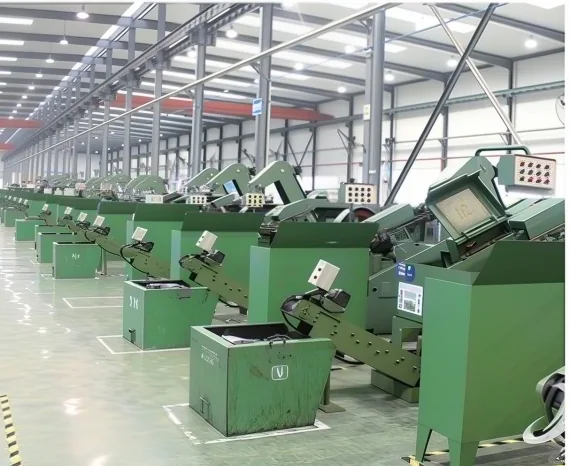
In the morning, a coil of wire rod is lifted onto the pay-off stand. The wire runs through the straightener with a fine, dry friction. It is cut, upset and headed; within seconds, a hex head has a shape. The operator does not watch the sparks. He looks at the first part that drops out and runs a caliper along the shank.
That is where a bolt’s journey begins.
On a purchase order, the same part is one line: DIN 933 M8×40, class 8.8, zinc plated. In the workshop, that line has to pass several checkpoints. If any one of them is loose, the customer may receive a part that will not fit, will not torque, or will be rusting three months later.
These are the nine checkpoints we watch in a hex bolt batch. Not every batch needs all nine, but most fastener risks live somewhere in this list.
The nine checkpoints
| Checkpoint | What we look at | Where it usually goes wrong |
|---|---|---|
| 1. Wire rod | Grade, wire diameter, heat number, mill certificate | Wrong steel grade, diameter out of tolerance, no traceability |
| 2. Heading | Head shape, head marking, shank length, concentricity | Eccentric head, wrong length, unclear marking |
| 3. Thread rolling | Pitch, major diameter, flank, thread start | Go gauge will not enter, no-go gauge passes, torn thread |
| 4. Heat treatment | Property class, hardness, mechanical properties | Under-strength, too hard, mixed batches |
| 5. Coating | Coating type, thickness, adhesion | Thin zinc, hydrogen embrittlement risk, colour variation |
| 6. Dimensions and thread | Length, width across flats, across corners, go/no-go | Length checked, thread never checked |
| 7. Visual and sorting | Cracks, burrs, handling marks, mixed parts | Different classes mixed in one carton |
| 8. Mating parts | Nut and washer fit with the bolt | Bolt enters, nut will not run down |
| 9. Packing and marking | Labels, quantity, moisture protection, pallet | Quantity wrong, label does not match the parts |
The table looks like factory business. Every row can also be written into a purchase order. You do not need to know the machines; you need to know what to ask.
1. Wire rod: the price difference starts with steel
A large part of a fastener’s cost sits in the raw material. “Carbon steel” can mean different grades, different wire-diameter tolerances and different heat numbers. The heat number on the mill certificate decides whether the batch can be traced back to its source.
Buyers often ask, “Why is this quote so much cheaper?” The first question is not the price. It is: Will the mill certificate travel with the goods, and do the grade and wire diameter match the drawing?
If the material is not stated, every later comparison is built on sand.
2. Heading: the head mark is not decoration
Heading sets the head shape, width across flats, across corners and shank length. The head marking — 8.8, the maker’s mark — is not decoration. It is the first identification of property class and source.
The two things most easily missed at the machine are head concentricity and shank length. One bolt looks fine. The assembly finds the interference. At first-article approval, head shape, marking, length and width across flats should be checked together.
3. Thread rolling: the thread is the functional surface
A thread is not acceptable just because it “has teeth”. Pitch, flank angle, major diameter and thread start all have to agree. The go and no-go gauges will settle the argument.
A coarse M8 thread has a 1.25 mm pitch; M10 is 1.5 mm; M12 is 1.75 mm. A drawing that says “M8” normally means coarse. If the customer needs a fine pitch, it must be stated; otherwise the part may look right and still not mate.
We ask buyers to put three things on the order: standard, thread size, thread tolerance. That is more useful than repeated confirmation that it is “M8”.
4. Heat treatment: a property class is not a printed number
8.8 and 10.9 are not numbers stamped on a head for appearance. They correspond to tensile strength, yield strength and elongation. Heat treatment decides whether a bolt deforms under load or breaks.
In the plant, heat treatment is not judged by colour. It is judged by batch records, hardness checks and mechanical test reports. High-strength bolts also need attention to hydrogen embrittlement risk, especially after electroplating. Not every product needs heat treatment, but when it does, it cannot be skipped.
5. Coating: similar colour, different performance
Zinc plating, hot-dip galvanizing, black oxide and passivation can all look “dark” or “silver” in a photo. Their corrosion performance is not the same.
- Indoors, light corrosion: zinc plating is often sufficient.
- Outdoors, wet or coastal: hot-dip galvanizing or a heavier coating system is usually more appropriate.
- High-strength bolts after electroplating: confirm the de-embrittlement process.
- Stainless steel: look at passivation, not only at how shiny it is.
A coating standard can be written as ISO 4042, ISO 1461 or the customer’s specification. Write the standard, not just the colour.
6. Dimensions and thread: length is the easy check
Length is the easiest thing to measure, and the easiest thing to trust. But a bolt’s problem is often not its length.
Width across flats, across corners, head height, shank length, thread length and go/no-go all decide whether the part fits. A go gauge that enters and a no-go gauge that does not is the minimum gate. For full-thread and part-thread bolts — DIN 933 versus DIN 931, for example — the thread length and the plain shank also have to be confirmed.
7. Visual and sorting: the work under the last lamp
After heat treatment and coating, the bolts are spread out and checked. Cracks, burrs, handling marks and mixed parts are found here.
The most dangerous defect is not a visible burr. It is mixed product: different classes, lengths or finishes in one carton. The customer’s line will not sort them out.
Sorting depends on people, light, fixtures and labels. It does not sound sophisticated. It is what makes a batch repeatable.
8. Mating parts: a bolt and a nut are a pair
Buyers sometimes source bolts and nuts separately, then discover that the bolt enters but the nut will not run down.
Hot-dip galvanizing changes the thread thickness; nuts may need to be tapped oversize. Different classes and finishes can also create fit problems. Confirm the mating parts as a pair, not the bolt alone.
9. Packing and marking: the delivery is not finished until it arrives
Cartons, pallets, moisture protection, labels and packing lists are not “last-minute” details.
A label should carry at least: product, size, standard, class, material, finish, quantity and batch. The packing list must match the goods. Export orders also need pallet dimensions, fumigation requirements, shipping marks and forwarder documents.
A bolt can be made perfectly and still fail the customer’s experience if the last carton is mixed or the label is wrong.
Three documents beat one “don’t worry”
When a batch ships, we would rather give the customer three documents:
- The approved specification: standard, material, class, finish, packing.
- The inspection record: what was checked, with which gauge, and what the result was.
- The packing list: carton number, quantity, gross weight, net weight, batch.
These documents do not replace physical quality. They make “this batch” comparable with “the next batch”.
A final note
Fasteners are small parts, but their quality is not guaranteed by a sentence like “we have done this for years”. It is guaranteed checkpoint by checkpoint: whether the wire rod can be traced to a heat number, whether the thread passes the gauges, whether heat treatment has a record, whether the packing matches the label.
If you are putting together a fastener purchase list, send us the drawing, the standard and the service environment. We can help you write the parts that need to be clear before the price conversation starts.
The real cost of a bolt is not its ex-works price. It is the line that stops when the part will not fit, rusts too fast, or arrives in the wrong carton.