
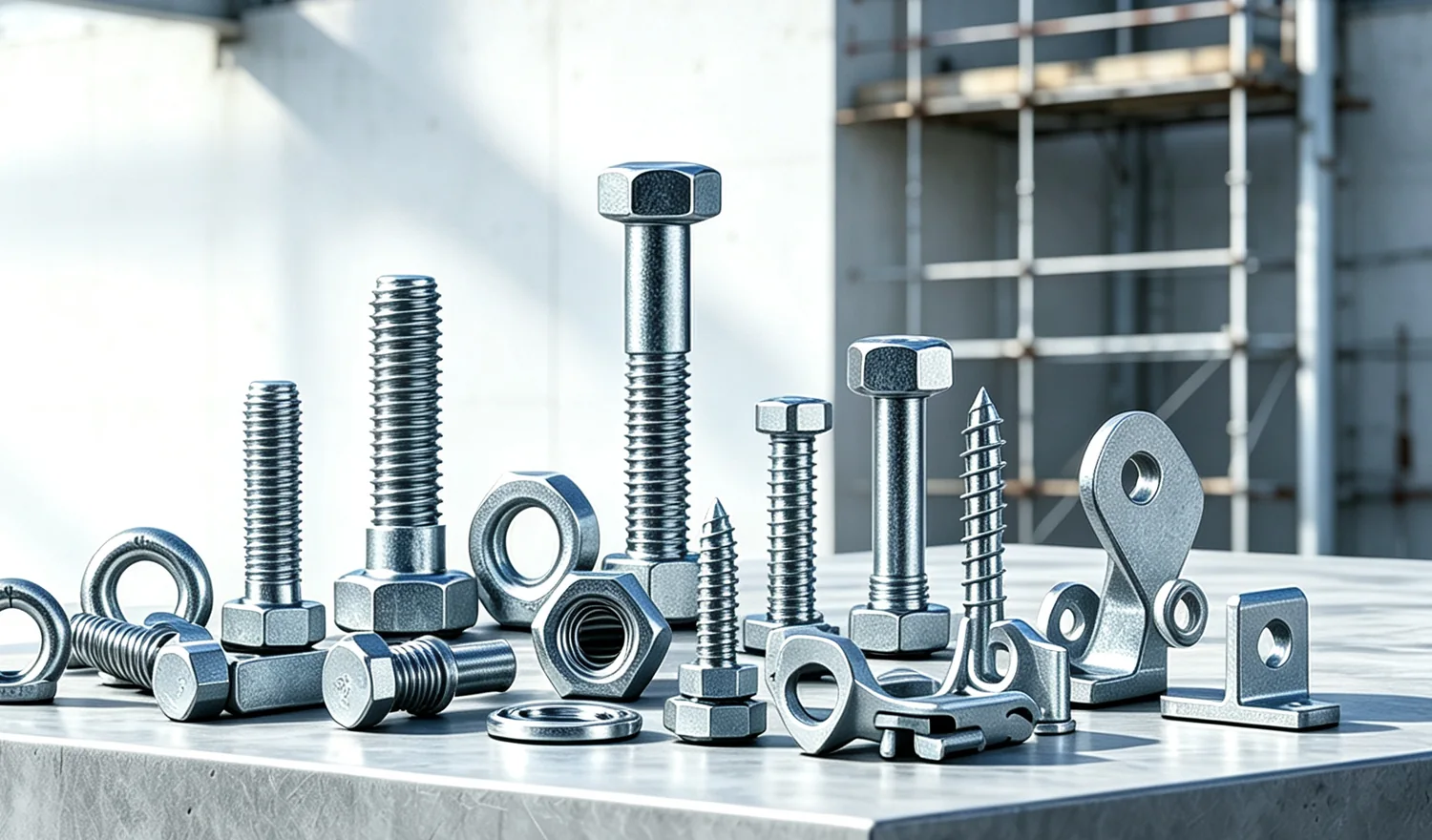
A hex bolt is one of the simplest parts on a drawing, and one of the easiest to specify incorrectly. The two references that cause most confusion are DIN 933 and DIN 931. They look alike, they are often stocked side by side, and they are not interchangeable in every joint.
The difference in one sentence
DIN 933 is fully threaded; DIN 931 has an unthreaded shank between the head and the thread.
That single difference decides where the bolt bears load, how the joint assembles, and whether the fastener is the right one for the drawing.
When a full-thread bolt is the right choice
A DIN 933 bolt threads all the way to the head. It is the practical choice when:
- the clamped length is uncertain or variable;
- the bolt passes through a clearance hole and threads into a nut or tapped part;
- the joint needs adjustment across a range of positions;
- the bolt is used as a stud-like fastener in a bracket or clamp.
Because there is no plain shank, the thread can sit inside the shear plane. In joints designed for shear, that reduces the effective bearing area and can put thread roots where the load transfers. A fully threaded bolt is not automatically weaker, but the joint should be designed for it.
When a partial-thread bolt does the work
A DIN 931 bolt leaves a plain shank under the head. The shank is slightly larger than the thread and can act as a close-fitting dowel in a reamed or clearance hole. Use it when:
- the joint carries shear and the shank is intended to bear on the hole;
- the drawing calls for an unthreaded section through a flange or bushing;
- a consistent clamped length allows the thread to sit entirely outside the joint.
The unthreaded shank also resists nicking and corrosion in the clamped zone, which matters in outdoor or wet environments.
What stays the same
Both references share the same hex head geometry and the same thread sizes. A DIN 933 and a DIN 931 bolt of the same diameter and property class use the same nut and washer. What changes is the length of thread and, in some standards, the tolerances on the shank.
| Feature | DIN 933 | DIN 931 |
|---|---|---|
| Thread | Full length | Partial, unthreaded shank |
| Typical use | Clamped joints, adjustment | Shear joints, locating shank |
| ISO equivalent | ISO 4017 | ISO 4014 |
| GB/T equivalent | GB/T 5783 | GB/T 5782 |
Do not forget the property class
The standard describes geometry, not strength. Two bolts with the same DIN number can be class 4.8, 8.8 or 10.9. The class affects tensile strength, yield strength and how the bolt behaves under preload. If the drawing specifies 8.8, a 4.8 bolt is not a like-for-like substitute even if the dimensions match.
How to specify the order
A complete line on a purchase order usually looks like this:
Hex bolt DIN 933, M10 × 60, class 8.8, zinc plated, 5,000 pcs.
Add the thread pitch if it is not the standard coarse pitch, the coating thickness if the environment is aggressive, and the packing format if the parts go straight to a production line. Those details are easier to agree before production than after.
If you are unsure which reference your drawing uses, send it to us. We will confirm the closest DIN, ISO or GB equivalent before quoting. See the bolt family or use the standards cross-reference for the full table.